iPhone 4S em Portugal a partir de 629 euros

Já é conhecido o preço do iPhone 4S em Portugal. A Apple vende-o desbloqueado a partir de 629 euros (versão 16GB).

RYNO: Moto eléctrica de uma roda

Tem um sistema de equilíbrio semelhante à Segway e promete competir com a Vespa e as scooters eléctricas.

DeLorean regressa ao futuro

Um novo modelo DeLorean vai sair da linha de montagem na Irlanda do Norte. Agora, eléctrico.

Veículos eléctricos livres de impostos em 2012

Os veículos exclusivamente eléctricos continuam isentos do imposto sobre veículos (ISV) em 2012.

Carro eléctrico: Preços em Portugal

Preços dos veículos eléctricos em comercialização em Portugal.

STAY HUNGRY, STAY FOOLISH!

Vídeo legendado e transcrição do discurso de 2005 de Steve Jobs em Stanford.

Showing posts with label LITHIUM. Show all posts

Lítio 'pode tornar Portugal rico'

No Expresso: Um estudo divulgado esta semana pela empresa de consultoria MarketResearch.com indica que a procura de litío para a construção de baterias de iões de lítio para a indústria automóvel vai quadriplicar ao longo dos próximos 10 anos.

O mesmo estudo revela que em 2010 o mercado mundial de lítio ascendeu a 11 mil milhões de dólares (€8 mil milhões), mas que em 2020 deverá rondar os 43 mil milhões de dólares (€31,5 mil milhões).

Alguns analistas do setor extrativo garantem ao Expresso que Portugal tem aqui uma oportunidade única para "marcar pontos" neste importante mercado, pois atualmente já é o 5º maior exportador mundial de lítio, e tem potencial de exploração para mais 70 anos. Estes dados são confirmados, aliás, num dos relatórios mais recentes do Departamento de Energia norte-americano.
Indústria automóvel interessada no lítio português

O problema é que Portugal apenas vai até à produção de concentrado de lítio, ou seja, não acrescenta mais valor ao seu produto, tendo que o vender em bruto para os smelters (proprietários de fundições) de outros países. Esses, sim, é que entregam à indústria automóvel o lítio pronto para ser utilizado em baterias de carros elétrios. São também estes intermediários que faturam uma parte considerável do processo de transformação do lítio.

O Expresso sabe, no entanto, que o principal produtor de lítio em Portugal está já a ser sondado por várias empresas multinacionais da indústria das baterias para carros elétricos, no sentido de formar parcerias que possam passar pela criação de uma fundição em Portugal. Ou seja, poderia ser um passo à frente no processo, em que o país acrescentaria valor ao seu recurso natural.

Para além da indústria automóvel, o lítio também, é utilizado na indústria eletrónica (telemóveis), farmacêutica e prevê-se que venha a ter cada vez mais aplicações na indústria aeroespacial e também na área militar.

A preocupação das construtoras de automóveis é tão grande em relação ao lítio que algumas já estão a entrar no capital social de algumas empresas mineiras em várias zonas do globo. A nipónica Mitsubishi ainda recentemente tomou posição em algumas empresas do sector extrativo, na área do lítio, em dois países da América do Sul.

Com estes avanços para a área mineira, a indústria automóvel quer garantir, de alguma forma, que não vai ter problemas no abastecimento dessa importante matéria-prima, para que a nova área de negócio dos carros elétricos, que agora desponta, não fique comprometida.
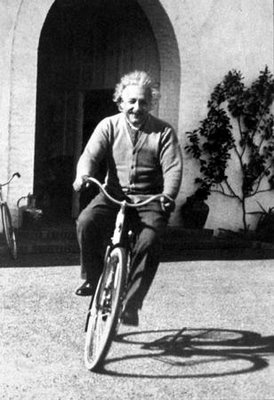
Einstein and car batteries: Without the magic of relativity, a car’s starter motor would not turn

From The Economist: Albert Einstein never learned to drive. He thought it too complicated and in any case he preferred walking. What he did not know—indeed, what no one knew until now—is that most cars would not work without the intervention of one of his most famous discoveries, the special theory of relativity.

Special relativity deals with physical extremes. It governs the behaviour of subatomic particles zipping around powerful accelerators at close to the speed of light and its equations foresaw the conversion of mass into energy in nuclear bombs. A paper in Physical Review Letters, however, reports a more prosaic application. According to the calculations of Pekka Pyykko of the University of Helsinki and his colleagues, the familiar lead-acid battery that sits under a car’s bonnet and provides the oomph to get the engine turning owes its ability to do so to special relativity.

Relative values

The lead-acid battery is one of the triumphs of 19th-century technology. It was invented in 1860 and is still going strong. Superficially, its mechanism is well understood. Indeed, it is the stuff of high-school chemistry books. But Dr Pyykko realised that there was a problem. In his view, when you dug deeply enough into the battery’s physical chemistry, that chemistry did not explain how it worked.

A lead-acid battery is a collection of cells, each of which contains two electrodes immersed in a strong solution of sulphuric acid. One of the electrodes is composed of metallic lead, the other of porous lead dioxide. In the parlance of chemists, metallic lead is electropositive. This means that when it reacts with the acid, it tends to lose some of its electrons. Lead dioxide, on the other hand, is highly electronegative, preferring to absorb electrons in chemical reactions. If a conductive wire is run between the two, electrons released by the lead will run through it towards the lead dioxide, generating an electrical current as they do so. The bigger the difference in the electropositivity and electronegativity of the materials that make up a battery’s electrodes, the bigger the voltage it can deliver. In the case of lead and lead dioxide, this potential difference is just over two volts per cell.

That much has been known since the lead-acid battery was invented. However, although the properties of these basic chemical reactions have been measured and understood to the nth degree, no one has been able to show from first principles exactly why lead and lead dioxide tend to be so electropositive and electronegative. This is a particular mystery because tin, which shares many of the features of lead, makes lousy batteries. Metallic tin is not electropositive enough compared with the electronegativity of its oxide to deliver a useful potential difference.

This is partly explained because the bigger an atom is, the more weakly its outer electrons are bound to it (and hence the further those electrons are from the nucleus). In all groups of chemically similar elements the heaviest are the most electropositive. However, this is not enough to account for the difference between lead and tin. To put it bluntly, classical chemical theory predicts that cars should not start in the morning.

Which is where Einstein comes in. For, according to Dr Pyykko’s calculations, relativity explains why tin batteries do not work, but lead ones do.

His chain of reasoning goes like this. Lead, being heavier than tin, has more protons in its nucleus (82, against tin’s 50). That means its nucleus has a stronger positive charge and that, in turn, means the electrons orbiting the nucleus are more attracted to it and travel faster, at roughly 60% of the speed of light, compared with 35% for the electrons orbiting a tin atom. As the one Einsteinian equation everybody can quote, E=mc2, predicts, the kinetic energy of this extra velocity (ie, a higher E) makes lead’s electrons more massive than tin’s (increasing m)—and heavy electrons tend to fall in and circle the nucleus in more tightly bound orbitals.

That has the effect of making metallic lead less electropositive (ie, more electronegative) than classical theory indicates it should be—which would tend to make the battery worse. But this tendency is more than counterbalanced by an increase in the electronegativity of lead dioxide. In this compound, the tightly bound orbitals act like wells into which free electrons can fall, allowing the material to capture them more easily. That makes lead dioxide much more electronegative than classical theory would predict.

And so it turned out. Dr Pyykko and his colleagues made two versions of a computer model of how lead-acid batteries work. One incorporated their newly hypothesised relativistic effects while the other did not. The relativistic simulations predicted the voltages measured in real lead-acid batteries with great precision. When relativity was excluded, roughly 80% of that voltage disappeared.

That is an extraordinary finding, and it prompts the question of whether previously unsuspected battery materials might be lurking at the heavier end of the periodic table. Ironically, today’s most fashionable battery material, lithium, is the third-lightest element in that table—and therefore one for which no such relativistic effects can be expected. And lead is about as heavy as it gets before elements become routinely radioactive and thus inappropriate for all but specialised applications. Still, the search for better batteries is an endless one, and Dr Pyykko’s discovery might prompt some new thinking about what is possible in this and other areas of heavy-element chemistry.

Keys to tomorrow's roads may be in lithium

From the Washington Post / St. Paul Pioneer Press: It's the lightest of all metals, skitters wildly on water and can unexpectedly explode. To mine it commercially requires an elaborate process involving drilling, evaporation tanks and chemical processing.

But if President Barack Obama is to fulfill his goal of putting 1 million electric cars on the road by 2015, a once-obscure metal crucial for the batteries in those cars, lithium, will probably be mined by the tens of thousands of tons here in the high Andes. Its boosters say lithium will one day rival petroleum in value, and that has prompted a race to secure mining rights across this craggy, bone-dry mountain range where vast salt flats contain some of the world's largest deposits.

"These are the most notable reserves at the moment," said Horacio Dias, a geologist who manages operations here for Exar, an Argentine affiliate of Canada's Lithium Americas Corp. "We think there is enough here to last many years." Mining executives are banking that lithium-ion batteries, which carry a longer-lasting charge than the lead acid variety long used in vehicles, will become cheap enough to help spur a mass market for electric cars or gas-electric vehicles. The Obama administration, trying to reduce America's reliance on foreign oil, has provided $2.4 billion in grants to car companies, battery makers and suppliers.

Whether the salt beds here in the heart of South America become a lithium mecca, as mining companies predict, depends as much as anything on American scientists as far away as Watertown, Mass.
There, A123 Systems, a battery technology company with roots at the Massachusetts Institute for Technology, is working to create lithium-ion batteries that would give electric cars a greater range — say, 200 to 300 miles — between recharging. A typical battery uses only a few pounds of lithium, but other components make such batteries expensive — by some estimates, well over $10,000 each — and bulky.

Failure could mean that cars such as General Motors' new Volt, a gas-electric hybrid that costs $41,000 before a $7,500 federal tax rebate to buyers, will remain too pricey for all but a small number of American car buyers. The Volt can go about 40 miles on an electric charge before the driver must switch to the car's internal-combustion engine. Fully electric cars can go 100 or more miles between recharges.

"We need to demonstrate that we can reduce the cost of this over the next four or five years to make the sale of these things take off without government stimulus," said David Vieau, chief executive of A123, which received a $249 million federal grant to build factories in Michigan. "It is a critical component for getting the volume up and helping drive the cost out while we make these batteries more efficient." Some of the projections on the future of electric cars — and lithium use in cars — are promising.

Nissan has said that by 2020, one in 10 cars worldwide may use lithium batteries. And Pike Research, a consulting firm in Boulder, Colo., said the market for lithium-ion batteries could expand to $8 billion in five years, from less than $900 million this year.

"Virtually every major car company around the globe has some sort of a hybrid electric vehicle program going," Vieau said.

Electric cars and their gas-electric cousins are not new. Ferdinand Porsche's hybrid was presented at a Paris exhibition in 1900. In the United States, there were 50,000 electric cars plying the roads in 1918. But big oil discoveries and Henry Ford's introduction of the Model T quickly established the dominance of the internal-combustion engine.

It is only now, with the United States consuming more than twice as much oil as it produces, that policymakers are considering a shift that would place less emphasis on gasoline-powered vehicles.

If that happens, the role of lithium will expand dramatically, with mining companies scrambling to secure the metal, said Ann Marie Sastry, chief executive of Sakti3, an Ann Arbor, Mich., company that is working to develop batteries with more juice. Lithium is now used in ceramics, to power cell phones and laptops, and even as a component in drugs to treat manic depression.

Much of the world has had its eyes on Bolivia, which President Evo Morales claims has infinitely more of the metal than all other lithium-producing countries combined. His socialist government is trying to lure mining companies, but Bolivia's terms call for those investors to also fund a Bolivian-based lithium-ion battery industry.

Read more...

NPR: The new gold rush? Lithium

Listen to this NPR story online: The Obama administration wants to see 1 million plug-in hybrid electric cars on the roads by 2015. That's going to require the production of a lightweight metal now used for everything from cell phone batteries to the treatment of mood disorders. It's lithium, and to get it requires going far from American shores. That has mining companies scrambling to secure mining rights in the far reaches of the world.

Listen or read more...


Related post: Bolivia could be the single biggest winner from the EV revolution

Who could be the single biggest winner from the EV revenge? Bolivia

From National Geographic: The salt piles at Bolivia's Salar de Uyuni, the world's largest salt flat, could shape the future of fuel. Beneath the salt lies a solution of brine that contains about half the world's reserves of lithium, or enough to make batteries for more than 4.8 billion electric cars.

The first automobiles that use lithium-ion batteries are just coming onto the market now, but these light, powerful batteries already have fueled an electronic revolution, and are found in virtually every kind of small gadget from laptops to iPods.

Now, thanks in part to the rush of new electric car models, demand for lithium may increase by as much as 40 percent over the next four years, a report from investment firm Byron Capital Markets said. That's leading countries with reserves—including Bolivia—to explore ways to tap into this burgeoning market.

Read more...